


They Gave Up the Game in 2004
“In the summer of 2002, after I had written an article in Esquire that the White House didn’t like about Bush’s former communications director, Karen Hughes, I had a meeting with a senior adviser to Bush. He expressed the White House’s displeasure, and then he told me something that at the time I didn’t fully comprehend—but which I now believe gets to the very heart of the Bush presidency.
The aide said that guys like me were “in what we call the reality-based community,” which he defined as people who “believe that solutions emerge from your judicious study of discernible reality.” I nodded and murmured something about enlightenment principles and empiricism. He cut me off. “That’s not the way the world really works anymore,” he continued. “We’re an empire now, and when we act, we create our own reality. And while you’re studying that reality—judiciously, as you will—we’ll act again, creating other new realities, which you can study too, and that’s how things will sort out. We’re history’s actors…and you, all of you, will be left to just study what we do.”
—Ron Suskind, “Faith, Certainty and the Presidency of George W. Bush,” The New York Times Magazine, October 17, 2004
Reality Is Created
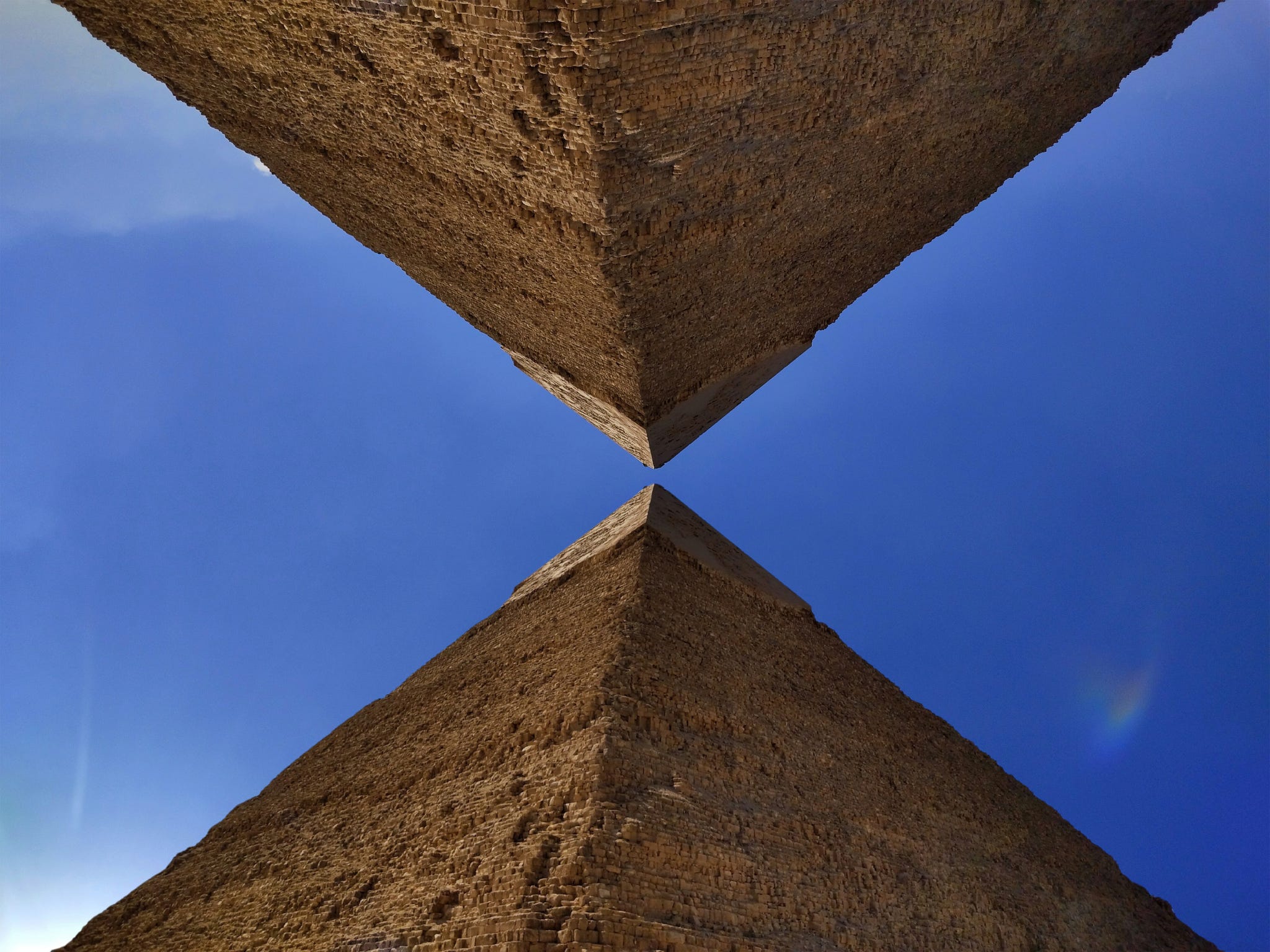
Few people would argue that Egypt’s Great Pyramid of Giza isn’t real. It exists, you can visit it, you can climb on the blocks, you can take photos of it, and you can find some uncountable number of people scattered across the planet who have visited it, climbed it, photographed it, and will claim, with full conviction and certainty, that it’s 100% real.
But the pyramid didn’t exist until it did—it wasn’t “real” until it was.
Even in ancient Egypt, devoid as it was of heavy machinery, it was possible to build a structure more than 40 stories high out of more than 2 million massive stone blocks that collectively weigh nearly six million tons. Who would have thought such a thing was possible before it was proved that it was?
Only its existence proved its existence is possible.
For centuries since, the pyramid has been explored, documented, studied, and gawped at. And even after all these centuries, that one pyramid has never been fully understood or explained. No matter how long we look at it, we will never fully see its entirety.
Humans flock to the pyramid because it exists; if it didn’t exist, there would be no flocking.
And if we want people to flock to a vision of the world we want to create, we must create things—real things in the real world—worth flocking to.
Reality Will Forever Outpace Understanding
Studying reality will never achieve a full or inerrant understanding of reality.
People with the most expertise in a subject area—let’s say, I don’t know, politics—are always dumping a dog’s breakfast of conflicting opinions on us and making a continuous stream of predictions that turn out to be wrong.
It appears that the people who have dedicated their entire lives to studying and practicing politics can’t accurately explain or predict political outcomes, and they certainly can’t reliably engineer the outcomes they want, no matter how really, really hard they try to convince themselves and others they can. It should be obvious by now that the smartest and most educated among us can lose to the dumbest and most ignorant. And yet our progressive intelligentsia appears largely blind to this readily observable fact, as demonstrated by all the losing happening everywhere.
Not only is reality too vast and complicated and baffling and mysterious and elusory, but reality is forever changing. Democracy didn’t exist until it did, and it can—as we are now seeing—die a quick and merciless death.
Understanding Reality Does Not Create Reality
Progressives must recognize the distinction between “studying reality” and “creating reality.”
Studying reality rests on the tacit, unexamined belief that there’s a fixed reality to study, and that by studying this reality, we will naturally obtain the information we need to understand what is real. And once we are equipped with this understanding, we will then be able to change the world.
But what happens when the world changes before we understand it?
Can our pursuit of understanding ever keep up with the pace of change?
If it doesn’t, can we ever understand anything?
And if we can’t ever fully understand anything (and we can’t), what’s preventing us from taking bolder and more assertive action right now?
I also like to study reality. And I like to study what people have learned about reality when they’ve studied it. Studying reality is great. It’s fun. It’s important and necessary. We need to study reality and try to understand it.
The problem with this unconscious and unquestioned belief—that there is a fixed reality that can be studied—is that it ignores a few readily observable and demonstrable truths: imagined things can become real, real things can cease to exist, and the reality we inhabit is governed by a host of made-up things—things that didn’t exist in the past but now do.
Twenty-five years ago, no one was walking around with a supercomputer in their pockets; today, you need a pocket supercomputer to read a menu in many restaurants.
Reality is made, then studied—and no amount of studying reality will create the reality we want.
If we want it, we must build it.
Build and Win First, Study Later
If we don’t audaciously and tenaciously build the reality we want to inhabit while also studying and trying to understand it—especially when authoritarian regimes are bulldozing new realities into existence across the globe—we could end up living in a reality in which studying reality no longer matters.
If we have $10 to spend and one hour to spend it, we need to invest $9.00 and 55 minutes on worldbuilding, and the remainder on research, until American democracy is once again functionally democratic and safeguarded by functional institutions.
Consider, for example, that we could end up, right here in America, living in a country in which things like legitimate universities, research grants, longitudinal studies, and professors no longer exist. Or perhaps “universities” may still exist, but exist only as ideological factories pumping out hardcore indoctrinates who then turn their preferred pseudo-realities into the reality we must all then suffer.
If we don’t relentlessly and unstoppably build and buttress and rebuild a world in which things like credible universities exist, we’ll end up living in a world in which they don’t. And when universities are vaporized, and all the research they have or would have generated is vaporized along with them, we’ll also lose access to the understanding of reality that research could have conferred upon us, which will then make understanding the world that much harder, which will then make us all more vulnerable to disinformation in its myriad forms.
In 2024, I suspect there were perhaps a handful of people who believed it would be possible, in only a few months, to undermine and rattle the foundations of the American system of higher education, a system that, of course, took centuries to build. I also suspect the people who are employed in higher-education systems were the least likely to have believed that the American system of higher education could be so grievously undermined and rattled so quickly. I wonder what they might say now.
It’s often the case that those who have the most to gain and protect—such as celebrated professors who are paid $50,000 to speak at a conference for a few hours—can be those who are slowest to realize they will lose what they’ve gained if they fail to protect it.
The Abdication of Creation
People in the reality-based community who believe that solutions emerge from the judicious study of discernible reality will lose the battle that’s currently underway, all around us, for the soul and future of America.
While we’re murmuring things about enlightenment principles and empiricism, and studying reality so assiduously, judiciously, and expensively, regimes of unprincipled, iron-willed fanatics will act, creating the reality that all of us will then inhabit.
And then they’ll act again, creating other new realities, which the reality-based community will continue to study, and that’s how things will sort out.
They will be history’s actors—if we let them—and all of us will be left to study what they’ve done.
Provided, of course, that things like modern liberal universities with grants, research programs, and professors still exist.
And increasingly, it looks possible they might not.
If we abdicate our power to build the world we want—right now, all together, as fast as possible, and in the most unyielding, hard-driving, all-in way we can collectively muster—the great pyramidal institutions of American democracy will be turned upside down, totter on at their pinnacle, and collapse into a ruinous pile of broken blocks to be weathered away by the sands of time.
~SEA
Last revised 9.11.26